



Design
Sheer curtains, explained
The most misunderstood window covering. Brilliant at one job, and often asked to do a different one entirely.
·6 min read
What a sheer actually does
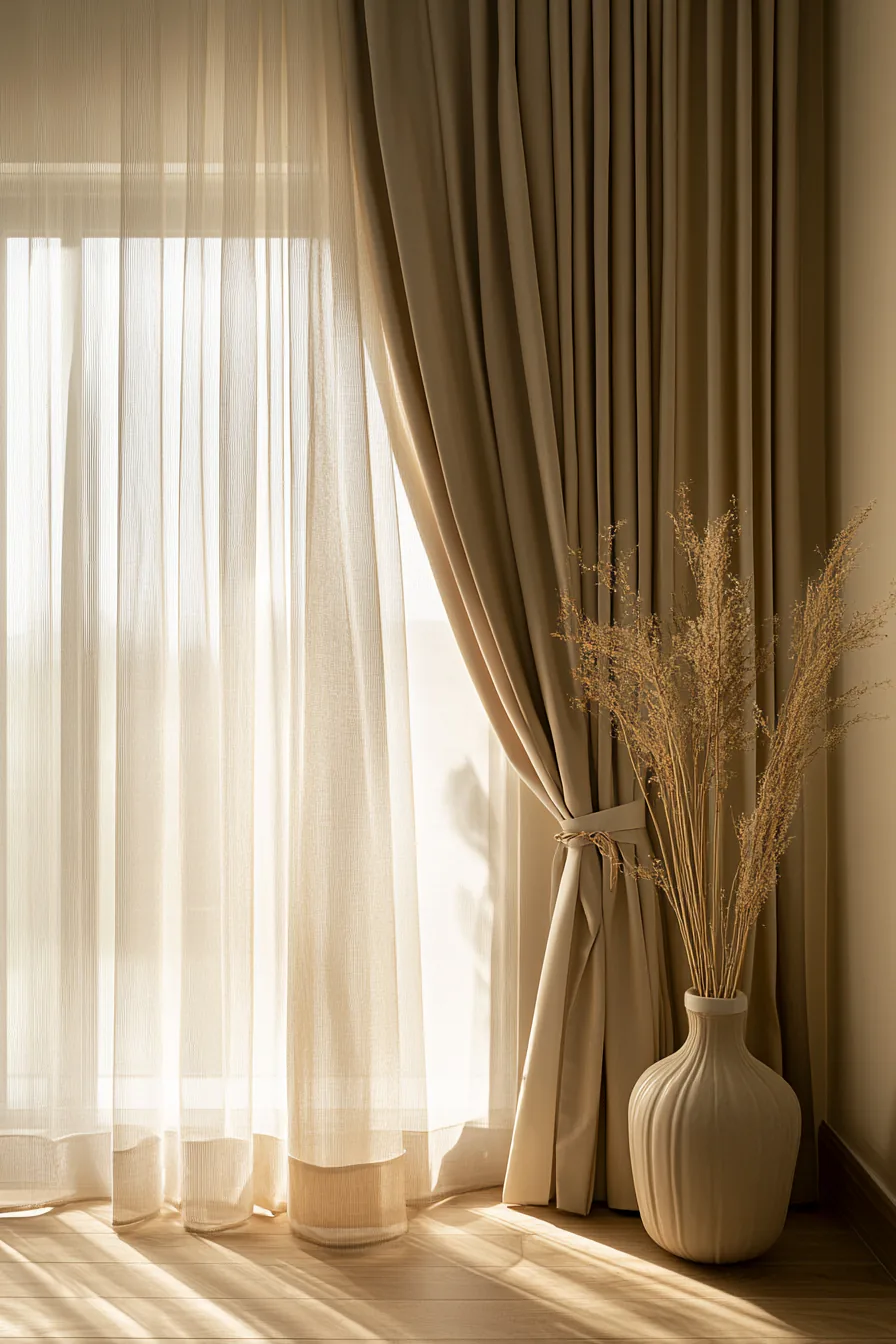
A sheer is a lightweight, translucent fabric that diffuses daylight. It scatters incoming light so the room stays bright but the glare goes, and it obscures the view in from outside during the day while you can still see out.
That daytime asymmetry is the whole appeal, and it is why sheers work so well in living areas facing a street or a neighbour. It is also the source of the most common misunderstanding.
The night-time reversal
The privacy works because it is brighter outside than inside. After dark that reverses: with lights on indoors, a sheer alone will show silhouettes to anyone outside.
This is not a flaw in the fabric, it is physics, and it applies to every sheer regardless of price. If you need privacy after dark you need a second layer.
Layering, done properly
The standard solution is sheers on the inside with blockout curtains on the outside, on a double track. Days are spent with the sheers closed and the drapes stacked back; evenings, the drapes close over the top.
This is also the best-performing arrangement thermally. The air gap between the two layers does real insulating work, which matters more in a Queensland summer than most people expect.
Where wall space is tight, sheers over a blockout roller blind achieves the same result with less stack.
Choosing the fabric
- Denser weaves give more daytime privacy but let through less light — there is a direct trade-off
- Fuller gathering makes a sheer look considered rather than skimped; skimping on fullness is the most common false economy
- Wider fabric widths mean fewer joins on a large window
- Modern sheers are far more practical than their reputation: many ranges are machine washable and hang without ironing
- Colour reads differently backlit — always assess a sample against the actual window, not on a table
Heading styles change the look entirely
The same fabric looks quite different depending on how it is headed. Wave fold, on an S-fold track, gives soft continuous curves and a contemporary feel. Pinch pleat is more structured and traditional. Reverse box pleat gives a flatter, tailored wall of fabric.
It is worth seeing these in person, because the difference is much more pronounced in the room than it is in a photograph.
Good to know
Common questions
Do sheer curtains give privacy at night?
No. Sheers give daytime privacy because it is brighter outside than in. Once the lights are on indoors that reverses and silhouettes become visible. Layer with blockout curtains or a blind for night-time privacy.
Do sheer curtains block heat?
They reduce glare and some radiant heat, but far less than a blockout or an external shade. For heat control on a hot-facing window, sheers should be one layer of a system rather than the whole solution.
Free in-home consultation
Talk it through with someone who fits these every day
Reading only gets you so far. We bring samples to your home, measure up and quote — free, across the Gold Coast, Queensland.